It is not that I mind that I have to do another portrait, but wonder minimally what else I may have come up with.
My wife wants me to do a portrait of her. Creatively it gives me a heading to steer in the perimeters of the project, so no complaints. It will be a learning venture and I will always look at it this way. Content and symbolism will still be achieved in the piece once I get my homework done.
My Influences and research:
I am influenced by Romanticism, especially the work of Ingres who I researched before. It is not the technical part of his work but rather the classic style that I feel is important of me to learn before I break out into my own. Of course my expectations of reaching that level of portrait is far from attainable due to my own skill and time frame.
Thanks to work in my last piece I am also encouraged to push my understanding of lighting effects. I have always been interested in the effects of Vermeer's work and hope to attain some level of skill with this. His use of lighting is popularly celebrated so I think it is a good place to start.
Somewhere between my ongoing technical growth and research in these two artists I hope to bring about an artwork that I my wife can like and I would be proud to place in her office or our home:)
I am not putting too much pressure on myself, if id does not come out great I can always do it again.
Her Influences:
I already have to include her personality into the piece. Knowing she also has a strong liking of Romanticism, but she would rather impressionism:)
Her homeland will be reflected in the piece but as in my last portrait I aim first with colours. Her hometown of Mostar, Herzegovina stands in my mind with allot of grey mountains, Lavender fields in the summer and rosemary bushes that grow wild everywhere. The teal blue of the Adriatic sea and the Neretva river are also important, but the I will contemplate with as I would not describe the region as colourful (coming from the Caribbean). Artists she is drawn to are Delacroix, Corot and Boudin.
Though I will reflect on her preferences because her portrait should reflect her personality; me as the artist must remember it is also how I see her and would like to illustrate that to the the viewer. But I hope to capture this in, posture, dress and gaze.
My size will be square (already part of my reflection of her personality), so most probably 36"x 36".
All left to do is a initial sketch to figure out layout and composition. The problem here I feel will be what to include as Ingres and Vermeer had allot in their pieces and I doubt I will have as much time. With that worked out I will venture into a photograph to work from and begin.
As Ingres portraits stood as period pieces with style of dress and furniture and indications I also hope to incorporate these. Vermeer was known for doing middle to lower classes doing everyday things so I will steer my creative exploration this way also.

Thursday, November 10, 2011


Portrait 2:Completion
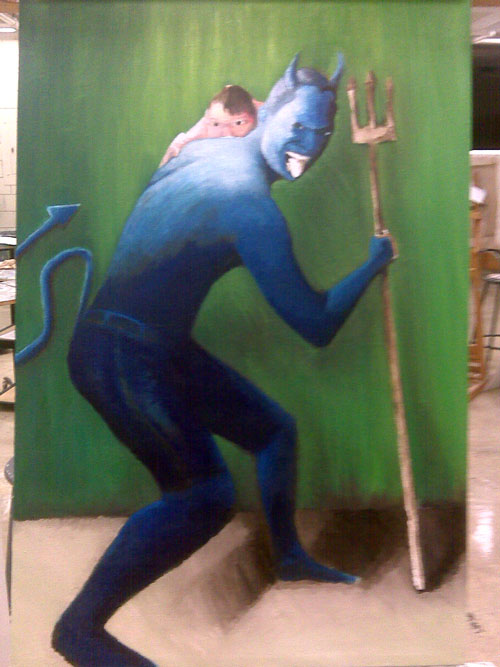
I had far too much fun with this piece while in mid process. Affected by the Trinidadian music in my drive; I had to switch to my everyday musical style to complete it.
My satisfaction with the technical work as it pertained to the human anatomy slowed my completion also. Every time I mixed blue paint it seemed to be different and I had to re touch the entire piece, but was encouraged with how the piece looked.
The lighting effect was very clear in my head but I struggled to let it make sense.
Though I was very happy with the outcome and what people's impressions were of the piece in critique, part of me will always hope that I did more in detail.
One good thing that came out of my enjoyment was a stretch in the background in learning a bit of what I see as impressionism, stumbling on a style that worked with longer brush strokes and heavier thicker paint.
Unfortunately I doubt it will be a style I will use in my next piece, but will further in future pieces.




Thursday, October 27, 2011
Portrait 2: Concept to Canvas
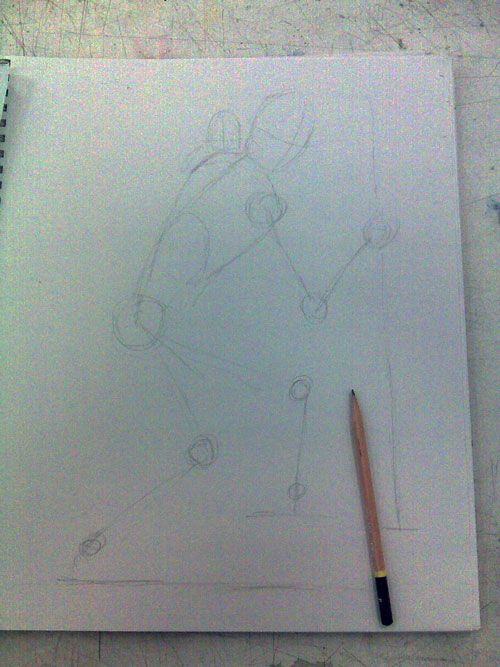
The risk of this idea is a little troubling, fighting full figure, full colour and full canvas is allot when I think I was scared of doing objects in black and white just two months ago.
None the less I am applying passion and logic as I always do with the hope to learn. The Decision of the pose and content took me the longest, actually researching thing and getting a few sketches down went a little easier than anticipated. Also music to fuel the fire took allot of searching and begging.
After making a few successful sketches my confidence grew, which were welcomed because after many steps to create a canvas I would hate to paint something I did not like, evidently I am more heavily invested in this project than I am usedto.
I fairly pleased with my start, but on review of what I have on canvas with past images; I feel I have made a structural error with the leg being a little too thick. I will have to figure out if it is acceptable to the piece or not.


None the less I am applying passion and logic as I always do with the hope to learn. The Decision of the pose and content took me the longest, actually researching thing and getting a few sketches down went a little easier than anticipated. Also music to fuel the fire took allot of searching and begging.
After making a few successful sketches my confidence grew, which were welcomed because after many steps to create a canvas I would hate to paint something I did not like, evidently I am more heavily invested in this project than I am usedto.
I fairly pleased with my start, but on review of what I have on canvas with past images; I feel I have made a structural error with the leg being a little too thick. I will have to figure out if it is acceptable to the piece or not.




Tuesday, October 25, 2011
When I was a young boy I was afraid ...
"When I was a Young boy I was a afraid.." Peter Minshall, Carnival Mas designer.
Minshall's quote probably best expresses what most children first feel when they see a Jab Molassie. As a child I hated Carnival, too many people too loud to many smells. Baby oil and Cocoa, paint, glue and feathers, horse dung and burning asphalt prompted me to cover my nose. I hated to go into Port-of-Spain, but my parents insisted though neither of them would prove to be true Carnival fanatics; I am thankful for their effort and my exposure.
The Jab Molassie group or "Band" would come "chipping" down the street for spectators to see, they were covered in either paint, mud or Cocoa mixed with oil. With horns on their head, a devils tail and a pitch fork to "jab" you; they would chant "Pay the devil, Pay the Devil" in unison to the rhythm as the beat tins, drums and bottles. They would use food colouring or "Kool-Aid" to make their tongues bleed enhancing the grotesque masquerade.
The idea was simple, give them coins or notes and they would leave you alone. Leave you clean. They typically terrorised children, but parents culturally would create fear in their children's mind long before the arrive.
This rite of passage is our baptism into the Carnival.
Years later having survived the mental trauma; hormones birthed an interest into the Carnival Masqerade or Mas. Opening oneself half naked in the hot sun in the middle of the capital city draws in a spiritual experience that all virgin masqueraders experience. The freedom is simply therapeutic. My "Monkey Gland raise" or the wild energy picked me out of all others around me and slowly the Jab Molassie surfaced.
I lived for Carnival and lived the carnival as a Jab Molassie. Honest and unafraid the "Wildness" in me was always welcomed socially. A fire-starter an Ice breaker, me and others like me brought the energy like a drug to make the party people forget, shrug off inhibition and be themselves if only for a while.
Now I must hide my energy in places far too polite to understand the beauty in uninhibited energy. Where persons rather appear polite than be honest. I have grown accustomed to the facade, but the Jab Molassie still remains ... or is it leaving me. A gift for someone far more deserving of its powers...
Jab Molassie

The differences among the various forms of devil mas were once distinct, but have become blurred over time.
Carnival ....
In 1498, Christopher Columbus landed in Trinidad and as was the practice in the so called age of Discovery and Exploration, took possession of the island in the name of the King and Queen of Spain. The island did not have the promise of immense wealth like the other countries in Spain’s Western empire. Trinidad was, therefore, largely ignored for over two hundred and fifty years.
In 1776, out of concern for this state of affairs, the Spanish king issued a Cedula of Population, which opened the island to colonization by the French. A second Cedula followed in 1783. This saw an even larger influx of planters from the French West Indian islands of Martinique, Guadeloupe and Saint Dominigue. Arriving also were Free Coloreds and Africans. The French brought with them their cultural traditions, language, dress, food and customs.
In 1797, Trinidad was captured by the British and was made a crown colony of Great Britain. The British immediately began the process of colonization as they had in Barbados and Jamaica two centuries before.
In this era, the period between Christmas and Lent was marked by great merrymaking and feasting by both the French and English. Historians of the nineteenth century wrote about the balls, fetes champetres and house to house visiting engaged in by the white upper class. It was also the custom of the British to impose martial law during the Christmas season. Military exercises were performed at the start of this martial law.
The Carnival celebrations between 1783 and 1838 were dominated by the white elite. Africans and coloreds (persons of mixed race) were forbidden by law to participate in street festivities. This is not to say that they did not celebrate in their own way in their compounds.
During this period also, there were numerous balls, parties and other entertainment. This gave the Africans some measure of freedom to enjoy themselves and engage in merry making. These festivities, along with the pomp and ceremony involved in imposing martial law, provided the Africans with ideas for some of the earliest masquerades for carnival.
The pre-emancipation carnival saw whites costume themselves as ‘negre jardin’ (field Negroes) and mulatresses. They also reenacted the Cannes Brulees (French for Burning Canes): the practice of rounding up slaves to put out fires in the cane field.
With the emancipation of the slaves in 1838 however, the door was opened for the full participation of the Africans in the Carnival.
Subscribe to:
Posts (Atom)